Categories
Played

Games of 2012: Playstation All-Stars Battle Royale

I’ve spent a lot of time in 2012 playing games, but not a lot of time writing about them. As I did last year, I’d like to tell some stories or share some thoughts about the ones that meant the most to me this year. I’ll be posting one a day until Christmas. See all Games of 2012 posts.
Playstation All-Stars Battle Royale

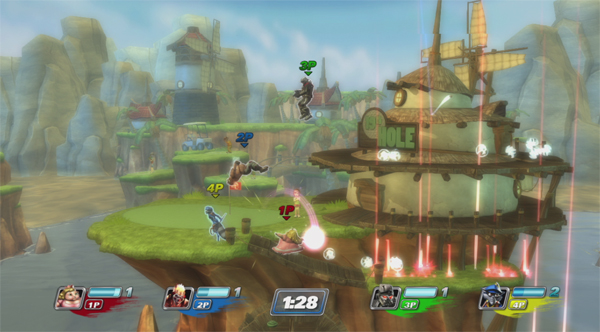
I come before you tonight to disappoint you. Playstation All-Stars Battle Royale is not the sleeper hit of the century, nor is it a bomb that would deserve a Guy Fieri-style takedown. I can’t remember the last time I felt so middle of the road about a game. (Most of this post will compare the game to the Super Smash Brothers series, which PASBR is widely accused of ripping off.)

The roster? It’s fine. There are some logical choices (Kratos, Nathan Drake, PaRappa, Ratchet); some fun outside choices (Noriko from Heavenly Sword, Spike from Ape Escape, and the feline majesty of Toro); some strange outside choices (Sir Daniel from MediEvil, Colonel Radec from Killzone); and some terrible choices (Dante from DMC, but the new one, not the traditional one; Big Daddy from Bioshock, hardly a Playstation classic). Thing is, if you’re comparing this to Smash Brothers, it’s not significantly different, as that roster follows that same range. There’s this weird belief that Smash is immune to bad characters, but the roster there has plenty of hot garbage. (R.O.B.? Wolf? Pokemon Trainer? Meta Knight? Lucario?)

If you are used to Smash play mechanics, the gameplay will probably feel wrong to you. Rather than piling damage onto your enemies and then smacking them off the level, you build your own energy meter – and then smack enemies off the level. This can feel very backwards, but that passes and eventually feels like a reasonable design decision. The game hinges on the risk/reward decision of triggering your super early or waiting for a later (and better) level. It’s not a better or worse decision, it’s just different.

The title does feel pretty skimpy in terms of content, not helped by a poor menu interface. Story mode, challenges, offline/online play – and that’s about it. Story mode are just straight up fights and no “adventure” levels (which suits me fine, as I didn’t really dig them in Smash); the challenges are in the Street Fighter style of executing on your move list. You can customize characters (via a weird per-character experience point unlocking system), but there’s no sense of history to Playstation past as the capsule toys provide in Smash.

There is one unique feature that PASBR does very well, and that is save syncing. Buying the PS3 copy of the game gets you a downloadable Vita copy for free; the games are identical, save some minor control differences to accomodate the Vita. Given the dual-platform nature, this could have easily become obnoxious, but through some very seamless network syncing of the saves, you can bash through challenges on the Vita version and have all your unlocks on the PS3 side. It just works, and works very well at that. It does help fulfill the promise of “console gaming on the go” that seems to be the only pitch of Sony’s that rings true.

Should PASBR exist? It’s hard to say. Sony has never been a company that’s developed any true mascots of its own, something Nintendo never had a problem with. But there are plenty of recognizable characters, and there’s nothing really wrong with pushing them into a strange fighting game. (I shudder to think what a roster would look like if Microsoft tried to do the same style of game.) PABSR sometimes feels like it’s trying too hard – the battlegrounds mash games up, which is fine until a Metal Gear breaks through on the Locoroco stage for no reason at all. Other times, it feels like it’s not trying hard enough – a game with so many fighting game experts in the credits shouldn’t feel so weirdly unbalanced.

It’s a few steps from being an easy recommendation to buy, but also far enough removed from being something I couldn’t recommend at all. It’s fine. Pick it up when it goes Greatest Hits? Or don’t. It’s cool either way.

Playstation All-Stars Battle Royale is available for PS3 and Vita.
Categories
Played

Games of 2012: Organ Trail

I’ve spent a lot of time in 2012 playing games, but not a lot of time writing about them. As I did last year, I’d like to tell some stories or share some thoughts about the ones that meant the most to me this year. I’ll be posting one a day until Christmas. See all Games of 2012 posts.

Organ Trail

By this point in popular culture, we should all be fed up of zombies. We’ve been on zed-word overload for the past few years – not just in the gaming industry but in culture overall. Just this year alone we’ve had Lollipop Chainsaw, Resident Evil 6, ZombiU, The Walking Dead[1. An aside about The Walking Dead: yes, yes, I know it’s been praised to the high heavens. I’ve been a little gunshy about Telltale’s episodic games as I’ve bought 4 seasons of their stuff but tend to never follow through through on them. I’ll probably give it a whirl next month. Sorry?], DayZ, Deadlight, Into The Dead…even Call Of Duty seems to be perpetually infested with the damn things. I’ve grown a little tired of shooting them in the head.

But I have to hand it to The Men Who Wear Many Hats – they’ve somehow managed to find a way to break my zombie ennui by smashing shambling hordes into the nostalgic edutainment fun of Oregon Trail – giving us [Organ Trail](http://hatsproductions.com/organtrail.html).

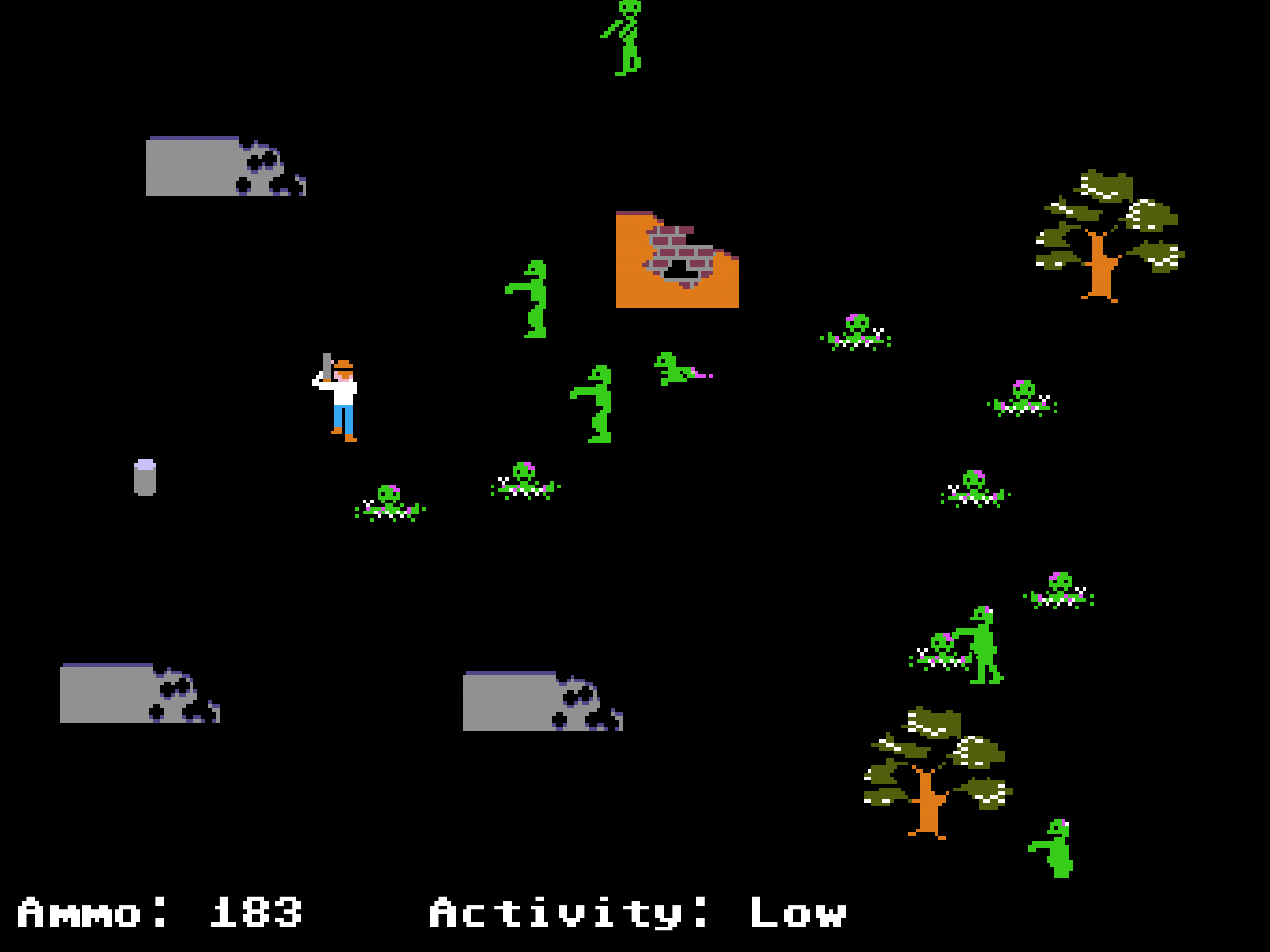
Plenty of people have tried to get the tone of MECC’s Apple II era classic right, but attempts to modernize it generally feel off. Just look at [Gameloft’s mobile version](https://itunes.apple.com/us/app/the-oregon-trail/id307519882?mt=8), which was at least kind of okay until they added in-app currency and tried to squeeze people for further money. Organ Trail has no qualms about sticking to the chunky graphics and limited color palette that was a staple of late 80’s computer labs.

It’s that level of dedication to really nailing that feeling that makes me love Organ Trail – it’s not really the zombies. Some grew up on an NES, others on the Genesis. But my gaming life would start on an Atari 2600 and then transition to the 4-color, no-sound-card world of a basic DOS PC.

When you complete a minigame in Organ Trail – maybe a shootout with bandits or just scavenging for supplies – the result screen pops up with a cheerful but glitchy BLEEEP~!. And when you tap the screen to dismiss it, you get the sound of a key being pressed on a very chunky keyboard. The bleep and the chunk are the best reminder of my gaming childhood I’ve had in a long time. Hits me right in the nostalgia muscle.

Organ Trail is available a universal iOS app as well as a Flash game.

Categories
Played

Games of 2012: Letterpress

I’ve spent a lot of time in 2012 playing games, but not a lot of time writing about them. As I did last year, I’d like to tell some stories or share some thoughts about the ones that meant the most to me this year. I’ll be posting one a day until Christmas. See all Games of 2012 posts.

Letterpress

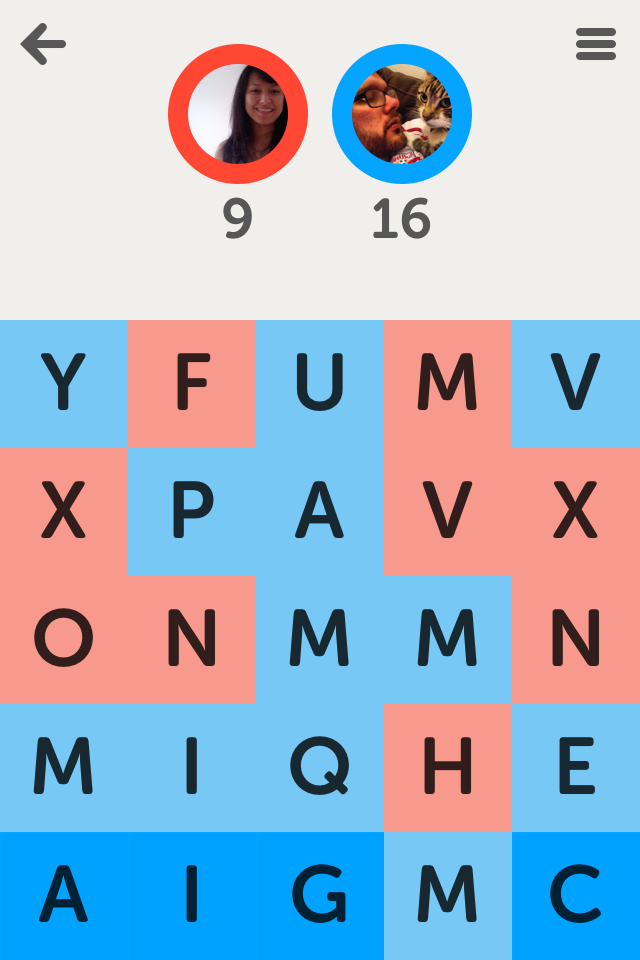
Loren Brichter’s Letterpress is all kinds of wonderful. This is probably not new information to you. A little bit Scrabble, a little bit Othello, all tied together with a perfect minimal design – it was a breath of fresh air in the iOS gaming scene this year. Not having played it is some sort of disservice to yourself.

Just a week or two ago, my friend Lia picked up a new-to-her iPhone 4S. As she was telling me about it, she made a telling comment:

> just realized: i will finally get to play letterpress now that everyone’s sick of it.

And that got my mind churning a bit.

I’ve been worried a bit lately about the longevity of good games. A strong game – especially one that relies on a network component – requires a constant level of care, feeding, and gamer interest to thrive. Be it [a studio closure](http://toucharcade.com/2012/08/30/freeverse-hit-with-massive-layoffs-less-than-a-week-after-co-founders-leave-potentially-shut-down-entirely/) or [middleware getting discontinued](http://www.rockpapershotgun.com/2012/12/10/the-spy-who-went-into-the-cold-gamespys-casualties/) or [servers being shutdown](http://www.gamespot.com/news/ea-shutting-down-over-a-dozen-game-servers-6366856) – games that once grew a following can quickly become unplayable through business decisions. (Of course, the crowd can always [head for the door for no discernable reason](http://www.forbes.com/sites/insertcoin/2012/05/04/draw-something-loses-5m-users-a-month-after-zynga-purchase/).)

One of the games I featured last year, [Glitch](https://vjarmy.com/archives/2011/12/games-of-2011-glitch.php), [just shut down last weekend](http://www.pcworld.com/article/2019337/this-is-how-you-shut-down-your-mmos-servers-for-good-glitchs-graceful-exit.html). MMOs come and go, as they have since the format became popular – and I don’t think I ever really expected Glitch to be around forever. But it died ahead of its time, and there’s no way to convey how it really functioned to someone who never experienced it.

Letterpress may not seem in danger of this. Loren released the game on his own, and so long as he is able to keep supporting it, it should be fine, right? Except for the small fact that he built it on top of Apple’s Game Center – and while I doubt Game Center would disappear almost overnight [as OpenFeint just did](http://venturebeat.com/2012/11/16/gree-puls-plug-openfeint/), these things can and do happen.

I work in IT; having just gone through Hurricane Sandy, disaster recovery has become the word on everyone’s lips once again. I urge people who work in the gaming industry to make sure they consider the unthinkable when architecting their games. What happens if the code libraries you use never get updated and break? What if you get bought out and can never work on the game again – and then that company discontinues it? What happens if your servers die? What happens if *you* die?

I’m reminded of Duane Blehm, a guy who churned out a few small shareware titles in the late 80’s for the Mac. If you grew up with classic Macs, you probably remember [Stunt Copter](http://www.d4.dion.ne.jp/~motohiko/stuntcopter.html), and maybe even [Cairo Shootout](http://www.youtube.com/watch?v=ID1NKqROe_4). Duane died unexpectedly in his 30s, which could have left his games stuck in limbo forever. Luckily, his parents opted to release the source code into the public domain – and [Stuntcopter still lives on](https://itunes.apple.com/us/app/stuntcopter/id308733440?mt=8).

I don’t want smart, well-conceived games like Letterpress to ever get lost to history; let’s do everything we can to make sure they don’t.

Letterpress is available as [a Universal iOS app](https://itunes.apple.com/us/app/letterpress-word-game/id526619424?mt=8).