Categories
Played

Games of 2012: FTL: Faster Than Light

I’ve spent a lot of time in 2012 playing games, but not a lot of time writing about them. As I did last year, I’d like to tell some stories or share some thoughts about the ones that meant the most to me this year. I’ll be posting one a day until Christmas. See all Games of 2012 posts.
FTL: Faster Than Light

It’s hard to think of a bigger source of both hope and anguish for the gaming community this year than Kickstarter. The success of some high-profile crowdsourcing campaigns brought on a massive flood of projects, many of them with lofty aspirations and promises that seemed too good to be true.

I’ve been told by a few friends that I have a “Kickstarter problem”, as I’ve now backed 34 projects. 19 of these have been for video games. FTL: Faster Than Light was the fourth game I backed, and the first one to actually ship. (None of the three I backed before it have shipped yet.) With just one play, the game reenforced my faith in the power of the funding model. If even a handful of games this enjoyable could come out thanks to Kickstarter or IndieGogo, it’s worth the risk.

I have never had a great relationship with space games. I have tried time and time again, but whether it’s a dogfighter ala Wing Commander or 4X games like Masters of Orion, there’s something about them that makes a game clicking with me much more difficult.

FTL avoids falling into that trap because it’s not rooted to the way space games normally flow. The pitch from the developers told me it was going to be different:

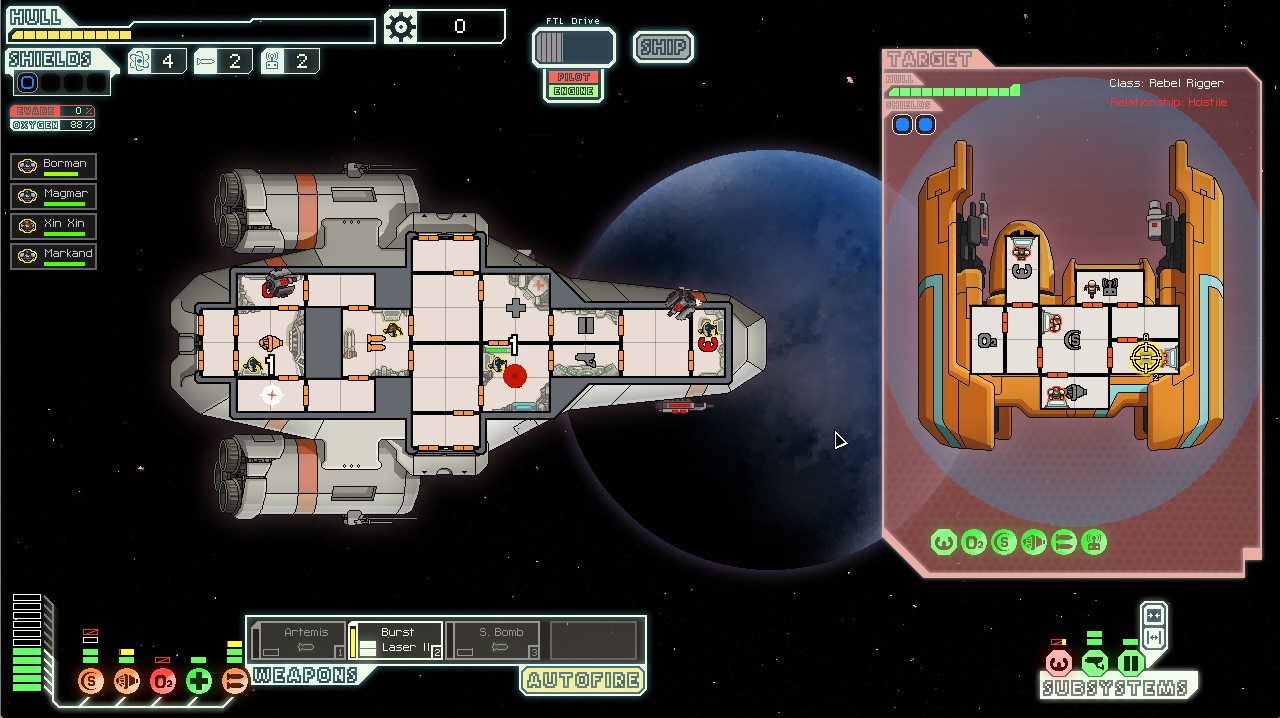
FTL is a spaceship simulation roguelike-like. Its aim is to recreate the atmosphere of running a spaceship exploring the galaxy (like Firefly/Star Trek/BSG etc.) In any given episode of those classic shows, the captain is always yelling “Reroute power to shields!” or giving commands to the engineer now that their Warp Core is on fire. We wanted that experience, as opposed to the “dog fighting in space” that most videogames focus on. We wanted a game where we had to manage the crew, fix the engines, reroute power to shields, target the enemy life support, and then figure out how to repel the boarders that just transported over!

The roguelike elements are (as is the case with most roguelikes) both fun and frustrating. There’s a variety of randomness in the systems you explore, but there’s nothing worse than wandering into a battle that wipes out a carefully upgraded ship you’ve spent hours with.

The combat is fulfilling in ways that dogfighting is not. It’s tactical rather than reactive, less about looping circles behind ships and more about running your crew around to boost and repair the systems you need to win the fight. A wide array of upgrades and components mean you can customize the tactics to your taste. Maybe you want to use energy weapons to spare yourself having to stock missiles, or load up on drones, or use a teleporter to beam your crew over to the enemy ship and take it down from the inside. The flexibility helps convey that feeling that you’re commanding the ship.

There’s also pressure driving you forward, which is rare in space games. You’re being chased by rebels across the map, which keeps pushing you forward. While you get some time to explore, sticking around for too long will lead to your inevitable death. There’s no market system to pump your resources with buying low and selling high – you have to acquire money and parts largely through combat or interactions with other ships.

It really is a wonderful and unique experience, and one that provides a shining example for what Kickstarter can do for the gaming industry. Of course, out of the remaining 18 projects, 14 still haven’t shipped – so it’s a little discouraging to have so many projects sending me constant text updates but not having games in hand. Hopefully by this time next year, I’ll have more examples than just FTL.

FTL is available for OS X and Windows.
Categories
Played

Games of 2012: Triple Town

I’ve spent a lot of time in 2012 playing games, but not a lot of time writing about them. As I did last year, I’d like to tell some stories or share some thoughts about the ones that meant the most to me this year. I’ll be posting one a day until Christmas. See all Games of 2012 posts.

Triple Town

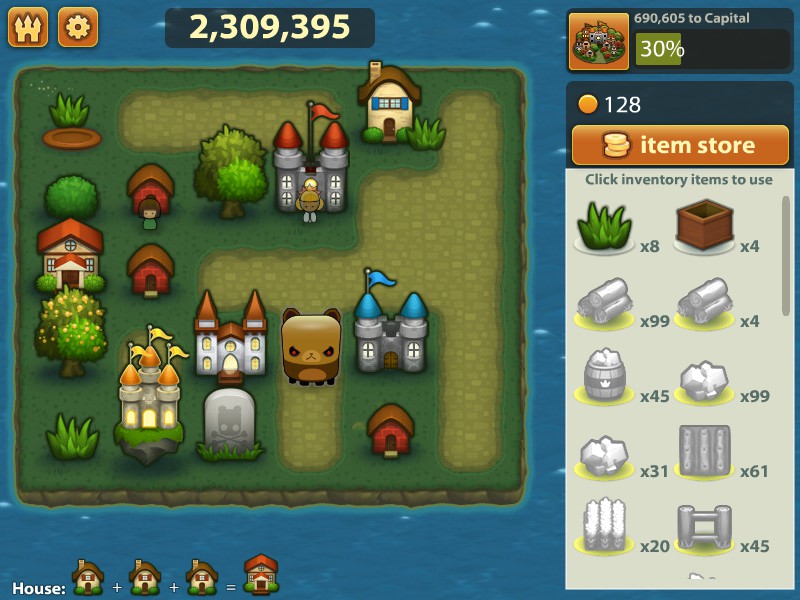
I generally try to avoid hyperbole, but not tonight: Triple Town is one of the best puzzle games I’ve ever played. I’m putting it on the level of Tetris or Bejeweled or Picross.

One sign of a great puzzle game is being able to explain it simply. I can reduce Triple Town down to three points:

  • You’re given a tile, and you place it on the 6×6 play field.
  • If three tiles of the same type are touching each other, they combine onto the last placed tile and upgrade to the next type.
  • Repeat until the play field is full, at which point the game ends.

Simple and unique. It was so unique, it was effectively stolen from the developers by a trusted partner and cloned, which forced Spry Fox to file a lawsuit.

The path of the tiles follows the natural construction of a town. Grass turns into bushes, bushes into trees, trees into small houses, and then larger and larger houses into castles. The game’s internal geometry clicks quickly, as you’ll quickly devise ways to block off areas to farm lower tier tiles into higher ones.

If that was all there is, Triple Town would be fairly mundane and straightforward. But then come those damned Giant Bears (or as they’re referred to around my house, “Chocobears”) and Ninja Bears. Occasionally appearing in your tile pile, they will get in the way of your attempts to put tiles down. Giant Bears will keep shuffling around until they have no path to follow – at which point they turn into a tombstone. Ninja Bears have to be killed off with a robot.

Like Tetris and Bejeweled, Triple Town balances on the fine line between executing your plan and dealing with curveballs. I have lost track of the number of times I’ve gotten into a flow of my build before an inconvenient tile pops up, forcing me to re-plan. The play field is relatively small, keeping you from having too much breathing room. For a puzzle game with no timer, it can get frustratingly stressful.

It’s been fun to watch Triple Town keep evolving on its own since its launch. When I first played the game, there was just a single map generator, but later updates introduced variations on the theme, like Peaceful Valleys (no bears, but lakes permanently block off some tiles). The recent Mac/PC release added a meta-town; successful upgrades in your meta-town yields items for use in regular towns, and vice versa.

If you’ve ever found yourself deeply addicted to a puzzle game, stay far away from Triple Town. It is crack for puzzle enthusiasts.

Triple Town is available on iOS, Android, Facebook, and Mac/Windows. My experiences were largely with the iOS version, but if you have a choice, get the Mac/Windows one, as it is the “ultimate hardcore version”.

Categories
Played

Games of 2012: Journey

I’ve spent a lot of time in 2012 playing games, but not a lot of time writing about them. As I did last year, I’d like to tell some stories or share some thoughts about the ones that meant the most to me this year. I’ll be posting one a day until Christmas. See all Games of 2012 posts.

Journey

I was born in 1980. It wasn’t too long after my birth before I could be found playing video games.

I have lived through the Atari age, the Nintendo hey-day, and the 16-bit wars. I have watched the popularity of arcades rise and fall in long cycles. As a song famously states, I was there.

As happy as I am to gripe about the state of the industry, there are positive threads that run counter to the negative ones. And one of the best success stories of those threads is thatgamecompany’s Journey.

Journey 2

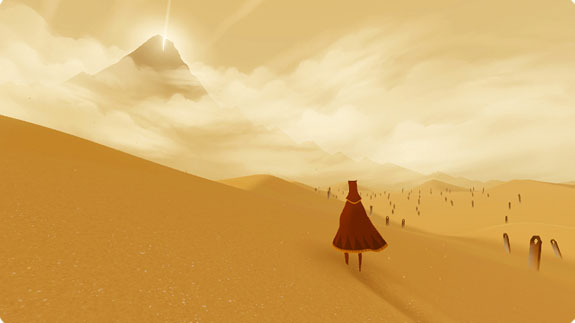
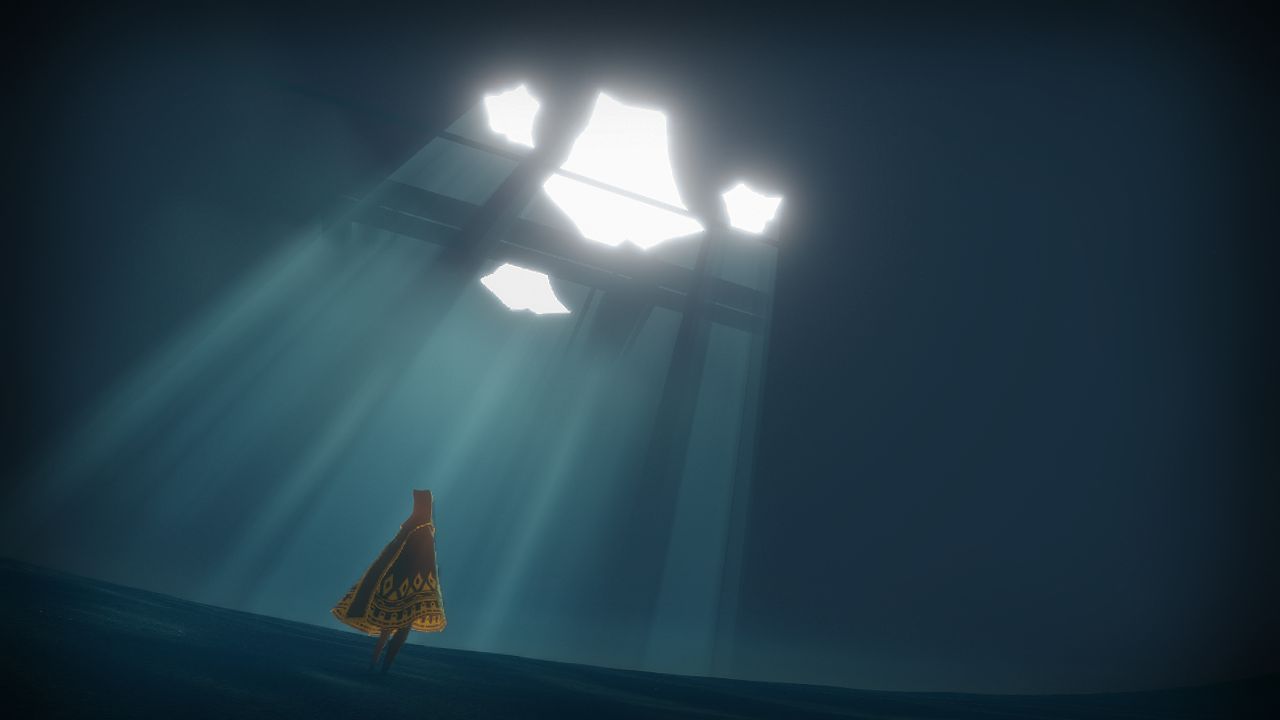
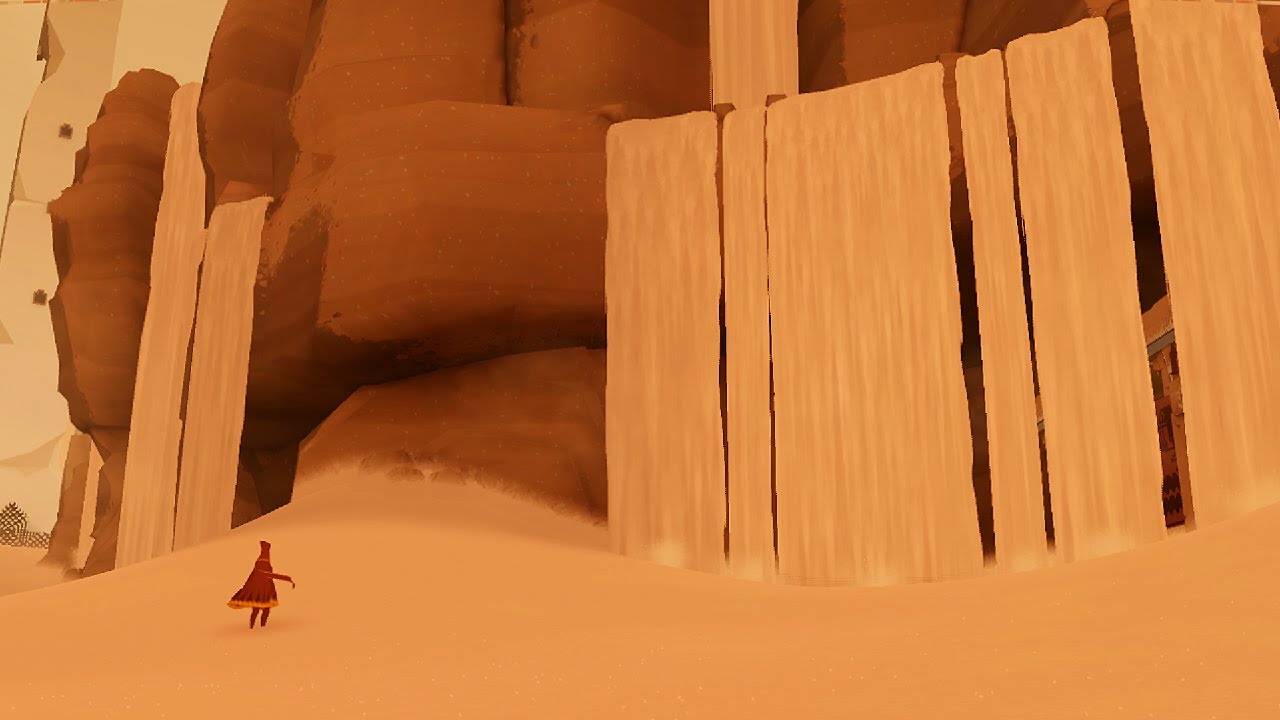
Journey is a beautiful but simple game. It resembles a 3D platformer, with a very limited control scheme – I believe there may be two buttons to use. Your goal is to travel to the light you see coming off the mountain in the distance. You may travel alone, or you may happen onto a companion – played by a randomly matched player on the network, who you can’t really communicate with.

When I consider Journey’s existence, this is what strikes me:

Journey came from a relatively small studio, one that started making games for USC game innovation lab research projects.

Journey was initially released digitally only, avoiding the cost and risk that comes with trying to get a title onto a readily shrinking number of retail shelves. (A retail version did come later, but it was a bundle of three games.)

Journey has a friction-free network function – companions drift in and out of the game, without server browsing or firewall reconfiguring or friends requests. It’s less a game with multiplayer and more a game that just involves other people.

Journey has a strange, ambiguous storyline that’s open to interpretation. I’ve read people argue it’s about life, or death, or rebirth, or companionship, or religion, or God. (I have my own opinions but I don’t wish to argue them tonight.)

Journey

Could a game like Journey exist at any other point in the gaming industry’s lifespan than right now? It feels like it could not, like the pitch would’ve been shot down and laughed out of the room by business executives. It needed to wait until the industry changed as much as it has in recent years.

For all the negativity I have about the gaming industry, I have to recognize that titles are emerging unlike anything we’ve seen before. I can only hope the industry keeps evolving, because the world needs more experiences like Journey.

(There are five games left in my Games of 2012 quiver, and all of them (save tomorrow’s game) share a similar pedigree: I can’t imagine them existing in any year other than now.)

Journey is available for the Playstation 3.